
Many parents hear the words "SEND reform" and assume it is something happening somewhere far away in government offices. Until the day it arrives in a meeting about their child.
A teacher says your child is struggling. The school suggests waiting a little longer. Maybe they need time to settle. Maybe they are just adjusting.
Months pass.
Your child becomes anxious about school. Work becomes harder. Behaviour starts to change. Eventually someone raises the possibility that your child might have additional needs.
This is the moment many families realise they have stepped into a system that can be slow, confusing and exhausting.
The government has announced plans to reform the SEND system in England. The intention is to fix a system that everyone now agrees is under enormous pressure. Families wait too long for assessments. Schools struggle to access specialist advice. Local authorities face rising costs.
The promise behind the reforms sounds reasonable. Identify needs earlier. Support children sooner. Reduce the need for families to go through legal processes to get help.
But what matters to parents is not the promise. It is what actually happens when a child needs support.
One of the most important things to understand is the role Education Health and Care Plans play in the current system.
Many parents do not pursue an EHCP because they want a legal document. They pursue one because it is often the only way to guarantee support is delivered.
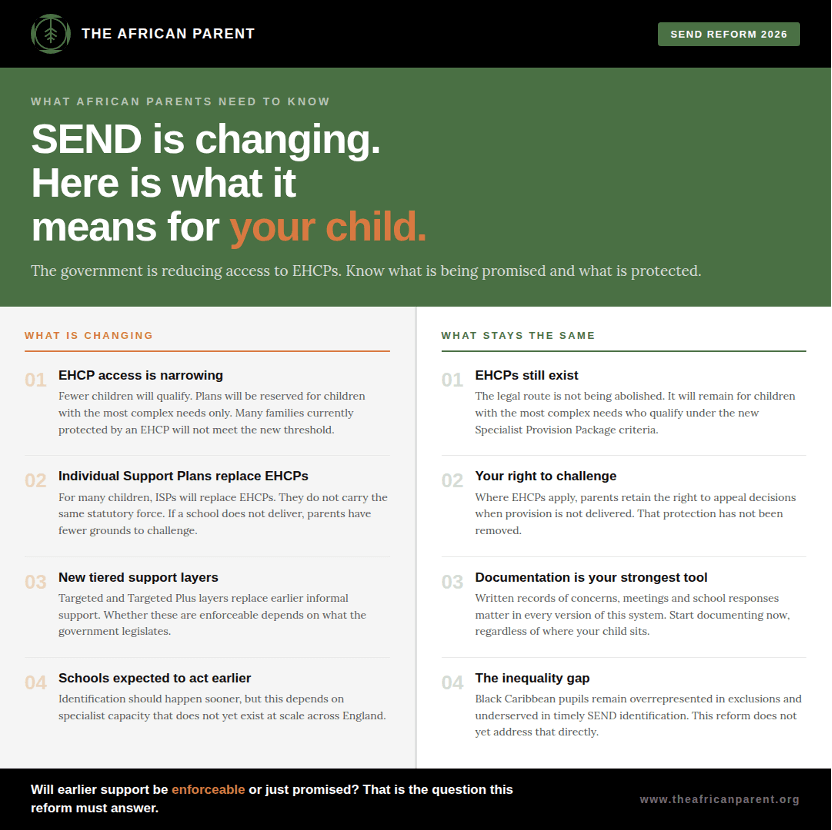
An EHCP names the provision a child must receive. If the support is not provided, parents have the right to challenge that decision. Without that protection, many families find themselves relying on goodwill rather than enforceable support.
The proposed reforms aim to reduce reliance on EHCPs. Instead, more support would be provided earlier through schools, using a tiered structure. Universal support for all pupils. Targeted support for those needing more. A higher level of targeted support for children with complex needs.
Some children would have something called an Individual Support Plan. EHCPs would still exist, but reserved for children whose needs require what the consultation calls a Specialist Provision Package. In practical terms, this means fewer children may qualify for an EHCP in the future.
The success of the reform depends on one question.
Will the earlier layers of support actually work?
If a school identifies that a child needs help, is there a clear responsibility to provide it? Can parents challenge decisions if support is not delivered? Will there be consistency between schools and local authorities?
If the answer to those questions is no, families will pursue EHCPs for the same reason they do today. It is the only way to secure support with certainty.
For many families, earlier identification is the part that matters most.
Parents describe a familiar pattern. A child struggles quietly for years. Concerns are raised but not taken seriously. Behaviour becomes the focus rather than what might be driving it. Parents are told to wait. By the time support arrives, the child has already lost confidence in school.
If schools can identify needs earlier and respond quickly, many children could be supported before that point. But earlier intervention requires something the system currently lacks in many areas.
The consultation acknowledges this directly. More than 64,000 children across England are waiting to see a speech and language therapist. Educational psychologists are in short supply. Many schools cannot access specialist advice when they need it. The government has announced funding and plans to train more professionals, but building that capacity will take time.
There is another part of the system that parents should understand, even if it is rarely discussed openly.
SEND identification does not happen in a vacuum.
Some children are more likely to have their needs recognised early. Others are more likely to be seen as disruptive before anyone asks what might be driving that behaviour.
Data shows that Black Caribbean pupils are excluded from school at disproportionately high rates. At the same time they are less likely to receive timely SEND identification.
That pattern is not accidental.
When needs are missed early, behaviour often becomes the problem schools respond to. Discipline replaces assessment. Support arrives late, if at all.
If reform does not address this reality, the same inequalities will simply continue under a new structure.
For parents trying to understand what all of this means, the most useful thing is not memorising policy language. It is knowing what questions to ask.
If a school says your child will receive additional support, ask what that support will look like in practice. Ask who is responsible for delivering it. Ask when it will start. Ask how progress will be reviewed.
If concerns about your child are raised repeatedly but no formal assessment takes place, ask why. Ask what steps the school has taken to investigate possible needs. Ask what evidence is being recorded.
If support is promised but not delivered, keep a written record of conversations and meetings. Documentation matters more than most parents realise.
Understanding the system should not be a requirement for securing support for your child. But until the system changes, knowledge remains one of the most powerful tools families have.
The government's reforms aim to create a system where children receive help earlier, schools feel more confident supporting additional needs, and families do not have to fight for support.
That is a goal most parents would welcome.
The real test will be whether the new system makes support easier to deliver, not just easier to describe.
Parents have heard promises of improvement before.
What they need now is a system that finds their child early, names what is needed clearly, and delivers that support without requiring a legal battle to make it happen.