
There are moments in parenting that feel like pure magic. Like when your child laughs from deep in their belly, you know… the kind that makes their whole body shake like a tiny earthquake of joy. Or when they cup your face with sticky hands (why are they always sticky though?) and say, "I love you," while chewing on half a biscuit, crumbs falling everywhere, mischief dancing in their eyes.
For a second, your breath catches and you think, "Okay … maybe I'm not completely ruining this tiny human."
But then Tuesday happens.
And suddenly you're whisper-screaming through clenched teeth, "If you don't put on your shoes RIGHT NOW, I swear I will …" while someone is crying, someone is yelling, someone is suspiciously quiet in the next room (which is somehow worse), and you realise you are all three of them.
In between the toddler tantrums, the living room that looks like a crime scene, and the seventh episode of Bluey (because let's be honest, Ms. Rachel got old), that familiar voice starts creeping in:
"Maybe I'm not good at this." "Maybe I'm ruining them." "Maybe I should have gotten a plant instead."
The village we lost
Here's what nobody tells you: parenting, in its truest form, was never meant to be a solo mission. It was designed to be shared. To be held by many hands, shaped by many voices, woven with stories, and supported by strong shoulders.
Somewhere along the way, that support system began to unravel. Modern life replaced community with isolation, and suddenly, we found ourselves parenting like we’re contestants on Survivor: Suburbia with families were expected to carry the full weight of parenting alone. Whether solo, partnered, co-parenting, or somewhere in between, every version of caregiving still needs what it always did: backup, compassion, and a village that shows up.
Even in homes filled with sound, cartoons blaring, kids shouting, dishes clattering, the quiet inside can still be deafening. Guilt hums in the background like a phone on low battery: constant, draining, and always close. Calm is attempted while internal fires flare. And all the while, social media offers a highlight reel of coordinated family outfits, neatly labelled toy baskets, and captions like “Grateful for these little blessings”, even though one of those little blessings was probably screaming over the last spoon of rice five minutes before the photo was taken.
Here’s the truth: everyone’s tired. Quietly shouting into pillows. Apologising to their children. Googling “how to reset your nervous system in five minutes” from a bathroom they’ve locked themselves in for a moment of peace.
For those of us raised in African households, the loneliness hits a different nerve. Childhoods were a symphony of “Do as I say!” and “I got smacked and I didn’t die!” Expression was discouraged, feelings were dismissed, and survival was often the only goal. Emotional nuance wasn’t on the menu, but slippers, belts, and wooden spoons were (and the range of their application? Impressive).
Parenting was theatre. Loud, unfiltered, often absurd and always taken seriously.
Many grew up in packed homes, surrounded by aunties giving relationship advice mid-stew, neighbours who knew what happened before it happened, and cousins who might as well have been siblings. The village was loud, opinionated, comforting, overwhelming, but present. If Mama needed rest, someone stepped in. If the baby cried too long, an elder arrived with herbs of mysterious origin and unshakable confidence.
Children belonged to the whole community, not just their parents.
But between immigration, urbanisation, and the pursuit of self-sufficiency, that village slowly disappeared. Now parenting often happens behind closed doors, through WhatsApp voice notes, and with tabs open asking: “Am I traumatising my child or is this just Monday?” In the quiet left behind, shame settles in like a persistent houseguest. It whispers, “Everyone else is coping better. Everyone else is doing fine. It’s just you.”
But is it?
Or is it simply the reality of raising humans with limited support, too little sleep, a full time job, and the echoes of another generation's parenting still playing in the background?
What we actually need
Another planner? Not necessary. Unsolicited advice wrapped in fake gentleness that hits like a slap from Aunty Bisi when someone forgets to greet her properly? Definitely not.
What we need is people. A real, living, breathing, biscuit-crumb-holding people. People who can look you in the eye and say, “Me too sis, me too!” People who won't flinch when you admit you're tired, confused, or questioning everything. People who bring jollof rice instead of judgment. Who sit with you in the mess and maybe laugh about it, while holding your baby so you can finally pee in peace.
People who get it! who understand that this generation of parents is attempting the impossible: raising whole children while healing the child inside. Trying to be gentle after being raised in noise. Trying to apologise when apologies were never modelled. Trying to validate emotions that were once dismissed with, “Stop crying or I’ll give you something to cry about.”
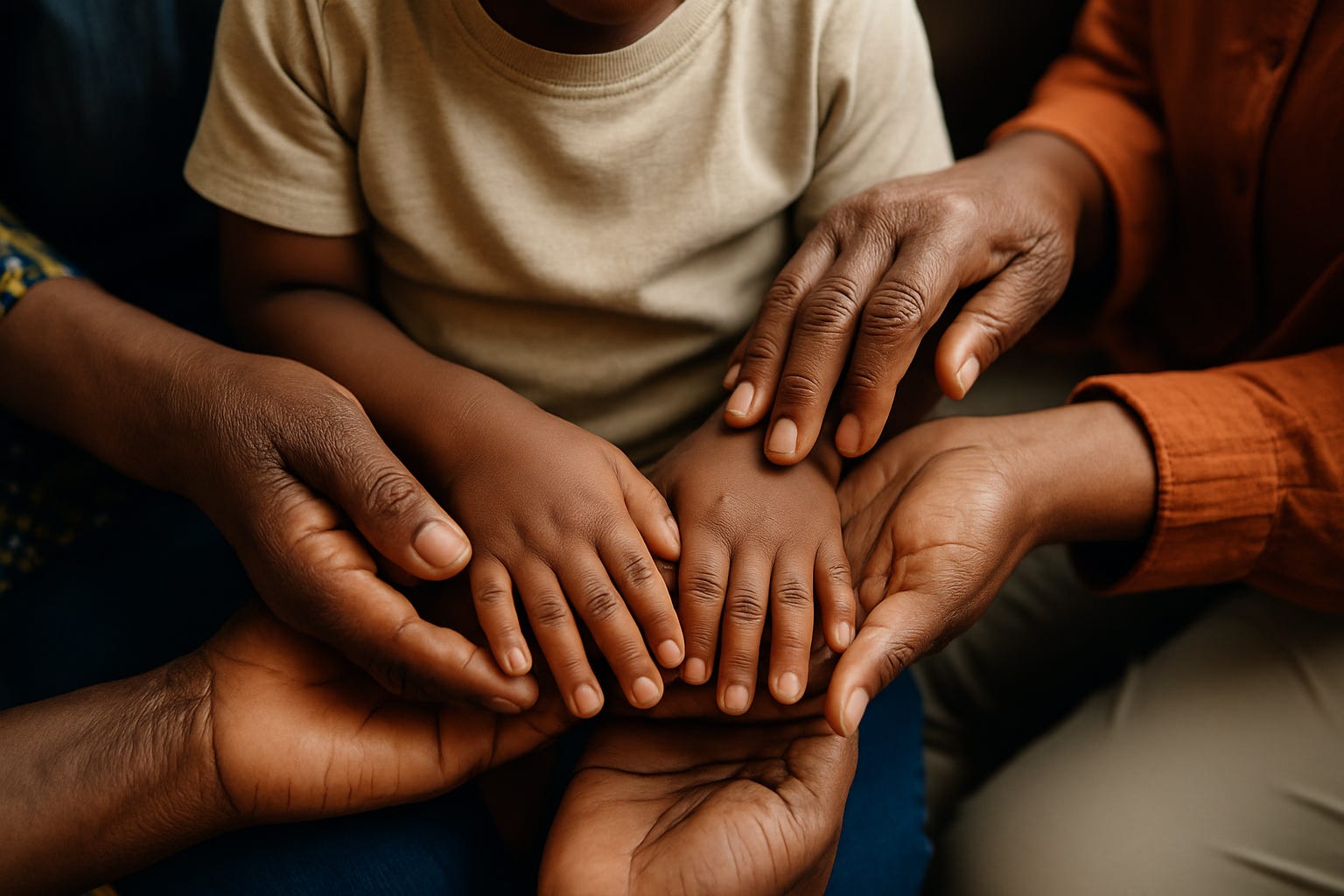
Rebuilding the village (And you're invited)
For the tired, the overwhelmed, and the ones quietly wondering if cereal for dinner again counts as a parenting strategy, something is being built. Not because all the answers have been found (they haven’t), but because no one should have to figure it all out alone.
We are creating a space where culture and healing are not opposites. Where parenting can be honest, not performative. Where traditions are honoured, but gentleness has a seat at the table too. A place where we can laugh about the shared African experience of hearing, “I don’t have money,” one week… only to see your mum pay in full for cousin Ada’s aso-ebi the next.
The African Parent community is coming soon and It’s for those who:
Are parenting with one hand while unlearning with the other
Want connection with people who actually get it, emotionally, culturally, spiritually
Are tired of smiling through the chaos like everything’s fine
Dream of raising children rooted in culture, but free from the cycles that harmed us
You don't have to be perfect (Thank God)
You just have to show up. You don’t have to do it all, fix it all, or have it all together.
Our kids don’t need a perfect parent. They need a present one. One who apologises. One who admits when they’re figuring it out. One who teaches culture and compassion. One who sometimes says "Because I said so" when appropriate, but also "Let's figure this out together" when it's time to problem-solve.
Ready to stop parenting alone? Join the waiting list here and let’s bring back the village, one story, one conversation at a time. Because we were never meant to do this without our people.
With love, soft plantain, and enough grace to cover every single mess,
- The African Parent
P.S. If you made it this far, you're already winning at life. Now go give yourself a hug and maybe eat something that isn't your kid's leftover nuggets.